Wednesday, July 24, 2013

Rhubarb: A Plebeian Transformation


Rhubarb: A Plebeian Transformation

One of the thrills of cooking is taking an overlooked or underused plant and cooking it in an exciting new way.

I have a friend who works late in a library one night a week. These sessions are often pretty boring, so one night she downloaded every rhubarb recipe she could find and then made a book out of them. And presented it to me.

There were some unusual concoctions, including rhubarb cordial (non-alcoholic) and rhubarb salsa (truly wonderful).

Rhubarb is too often treated with contempt. The prevailing attitude is that if it grows like a weed, it must not be very interesting, culinarily. Aside from dumping it into rhubarb strawberry pie, most people don’t do much with it. So I decided to enlarge my rhubarb repertory.

Somewhere I have a recipe for rhubarb bread given to me by a dyspeptic young wife who happened to be an excellent country cook. It is delicious—as moist and tender as zucchini bread but with a lovely tart edge that cuts the usual cloy of such dense, heavy sweets.

But there is still a Fridge Clean Out Day quality to the recipe that makes me suspect that if there were a few old tires lying around, they too would be incorporated into a loaf and served up with a smile.


My mother used to make Rhubarb Ginger Jam, which she got from a wonderful Scottish friend. I got the idea for this cake from that. I think it might top carrot cake in its surprising flavor.

Rhubarb Ginger Cake
2 c finely ground raw rhubarb
2/3 c sugar
2 c flour
1 ½ t baking powder
½ c oil
1 egg
1t vanilla
½  c crystallized ginger, chopped very fine (1/4 “ dice, max)

Grease and flour 2  9” cake pans, line with parchment paper.
Preheat oven to 375.
Whiz the rhubarb in a food processor or chop very fine.
Add sugar, whiz again.

Mix flour and baking powder. Add to stuff in food processor.
Whisk together oil, vanilla and egg. Add to mixture in food processor. Whiz. Then add ginger, whiz once more.
Pour into cake pans.  Bake 25-30 minutes, or until an inserted toothpick  comes out clean.

Cool in pans for 10 minutes
Then cool on racks for another 20 minutes or so, remembering to peel off the parchment paper.

Assemble and frost with your favorite cream cheese frosting. I sprinkled bee balm (monarda didyma), marigold and bachelor button petals--all of which are edible-- over the cake. This recipe makes a smallish cake—each layer under an inch high.

Cooking is a quotidian art form.  People need to eat, with a few decent recipes and a little know-how, a cook can bring good cheer and sustenance--if not always delight-- to the table. The terrible mistakes can go onto the compost heap or into the dog’s dish. Not a lot of pressure, and it’s nice to practice an art form that people know they need.
 I guess that’s it: with cooking you don’t have to battle the popular Philistine notion that people don’t need art. At least twice a day, that particular lie is scuttled.

While I’m pressing my case, let’s take this another step: cooking closely resembles writing fiction, because you are transforming raw materials—either experience or somewhat uninspiring bits of plants and animals —into something nourishing, interesting, welcoming, even delectable. Other people can enjoy it, and it becomes a new way of experiencing the world. It is deeply reassuring: we humans (surely the nuttiest, most nervous species) have found safe harbor in our often hostile environment. As literature assures us that we are not alone, good cooking assures us that we are not adrift.

And it’s a continuum, isn’t it? At one extreme end of the spectrum, say, is the much-touted Danish restaurant, Noma, which serves deep fried reindeer lichen. I have never eaten there, and have mixed feelings about tasting menus, generally.  But I am intrigued by using wild foods, and by eating (way) out of the supermarket box.

Some of the Noma menus described online are downright peculiar, but I think such an experience is analogous to attending an haute couture fashion show and seeing work by the late, and very great, Alexander McQueen. Few other designers come close to his audacious vision.
Sadly, I have nowhere to wear a bird’s nest on my head, or antlers festooned with lace. Perhaps I could try it for Halloween, the plebeians’ Let It Rip holiday. But I will go lichen hunting, and in the meantime, make a Rhubarb Ginger Cake.


Sunday, May 26, 2013

Salamander Eggs in the Hemlock


“Look at nature, work independently, and solve your own problems.”
—Winslow Homer

Nature is, of course, the essence, the greatest example of creativity. I was reminded of that when we were cleaning out the old pool. A huge hemlock had fallen into it during Hurricane Sandy. Marshall had sawn up a few of the logs, but some of the tree was buried in snow and he couldn’t get to it. Things were no easier come spring, when the drain had clogged with gunk and the water was chest high, the tree half submerged, still.

We rented a water pump at True Value. It was a solid little workhorse with three inch suction and discharge hoses. They said that it didn’t matter if you had the machine on the edge of the pool and stuck the suction hose vertically down. Oh but it did matter. The engine had to work too hard to pull the water up, and we got only the most pitiful trickle of water for our trouble.

That night Marshall downloaded Honda’s instructions, which said to have the suction hose as horizontal as possible. The next morning, we put the pump in the pool, at the dry end, and soon had water gushing out.
            As the water receded, we noticed blobs of jelly with little black dots in them lying on the leaf debris in the pool, and one suspended improbably on a hemlock branch. I carefully collected them in a bucket, added some water and put it aside.
             After about five hours of pumping, the pool was almost dry. I started raking up the old leaf muck and found the most beautiful black salamanders with yellow spots hunkered down under the leaves—fifteen of them in a ten foot stretch of muck. I carefully put them into another bucket and brought them to the little stream that fed the pool. I put them in a mound of leaves right by the water.

            When I brought the pump back to True Value, I started talking with a woman who seemed to know a lot about spotted salamanders. They need to be in a vernal pool, i.e., no fish to prey upon them. They lay their eggs and then burrow down beneath the leaves; in fact their other name is mole salamanders. They can live to be 32 years old and usually return to the same vernal pool to lay their eggs every year.
            Now we have to find a good vernal pool to hatch these eggs. The upper pool that feeds the swimming pool is going to be dredged, since it’s filled with silt over the years. But only one side can be reached with the backhoe. So they’ll be placed carefully on the other side.
            Fingers crossed. I gave eggs to two different science teachers in two different states with two very different set-ups. The one in Mass says that 10% have some sort of activity going on, the rest of hers have withered. No word from the teacher in Vermont, though when I dropped his eggs off, he thought the eggs with a little white around them might have some sort of fungus.
            It’s a nail-biter. I want all 500 (or so) to thrive and live rich lives--to the age of 32, at least. But not all of them will—and I hope my intrusions have not doomed them.
           
            I’m rewriting my novel, current working title, Please Love Your Life. It’s mostly cutting right now; Amy Hempel’s advice is good—cut out the boring parts. I go through cycles of worry and delight, trying to keep some equanimity in the process.

Every inspiration is a surprise, like those eggs, dangling from hemlock branches. I try to do right by them; sometimes it works. What I learn from nature is to keep trying, with the same wild hope every time.


Thursday, May 2, 2013

Going Really Public


Going Really Public

Recently I’ve been sent a lot of pieces of writing. I’ve learned enough about writers, especially fledglings, to know that people rarely want a critique. They usually want to be told they’re talented, to keep going, that what they have to say is important. From time to time, I’ve sought advice, and have gotten some very kind encouragement. I’ve also been scalded.
So I’ve been thinking about the ways we go public with writing, and how we can undermine ourselves by doing it half-heartedly.

            I suspect there is no more poisonous myth than that of Max Perkins taking Thomas Wolff’s enormous manuscript in hand, and editing it into an American masterpiece. It has fostered a terrible fantasy (particularly among young writers and grad students) in which  a writer can turn in an unfinished, formless pile of prose and have someone else transform it into art. It fosters laziness, entitlement and isolation in writers. Before, that is, it kills their talent.
            It happens at other stages in the creative process, too, alas. A writer I know has a habit of announcing he doesn’t have the knack for self-promotion, he just wants to do his work and have other people sell it. The implication is that he is too pure, too nice, to sully himself in the marketplace.
             I realize I’m talking about two different things, editing and selling, but I think they might be more closely related than they seem at first glance. Because in both enterprises, one must consider the reader.
Many of us enjoy the glorious independence writing gives us creatively. At its most basic, there is just a pen and a piece of paper to accompany the writer’s imagination--no committees, no votes, almost no limits. But if someone else is to read your work, you want to make it easy for her to follow your thinking, be swept away by your ideas and not distracted from that delicious journey by mistakes.
Soon enough one must edit: for clarity, for pace, to make the work more engaging. One must consider the reader. Is the piece clichĂ©d? Does it insult the reader’s intelligence or is it confusing? There are, alas, myriad ways for a writer to give up, and cling to the isolation that makes for self-indulgent writing.
And even the most assiduous self-editor has blind spots, or places where she just flags in getting the idea, in all its richness, across. Which is why another pair of eyes­‑‑or many pairs—can improve a book immensely. That collaboration is a fascinating one. You can have a real and very gratifying meeting of the minds with your editor(s) that pulls you from your ivory tower with a jolt of recognition.
           
Selling a book, whether to an agent, editor or book buyer, you have to capture the reader’s imagination immediately.
It’s true that you face rejection, indifference, other egos, competition. It’s scary. But it’s also a tremendous opportunity to connect with a reader. All readers want to be captivated, even the most dismissive and cynical. When that connection happens, it is transcendent.
The social media now available give us the opportunity to learn about our readers in many new ways. Let’s be curious.
I’m on my way to “The Muse and The Marketplace” Writing Conference in Boston. I’m hoping to learn more about social media, those powerful means suddenly at our disposal to get our words out as never before. I’m at least as nervous as I am curious and excited. Will I be up to the task of all that communicating?
We’ll see. The ivory tower now has wifi.

Monday, February 25, 2013

Creative in the Kitchen


Happy end of February….

I have just discovered a wonderful cookbook, newly out in paperback, so not all that new to the rest of the world, the brilliant and funny: Make the Bread, Buy The Butter, by Jennifer Reese. She prices out the cost of convenience foods vs. homemade, but here’s the genius part: she also factors in the hassle, the quality and the fun.
In other words, for once it’s not just about the dollars and cents.
Haven’t we all had that stubborn economizing voice whispering to us in the grocery aisle when faced with an absurdly expensive convenience food? “Are you kidding me? I could make it just as easily, and it would be better! Moreover I would be thrifty and uphold the lofty and creative tradition of home cooks who will not be dictated to by the ad department of some giant corporation!”

Here’s what else: the recipes really work.
I have made: the Fig Newtons, which are far superior to Nabisco’s, the Margaritas, which were the best I’ve ever had, the chicken soup with rice, lemony Greek style, which for some reason, I’ve always shied away from, and the croissants. A day into that last project I was convinced I’d killed off the yeast with too-hot milk. But no, it worked. I served a couple mini-croissants to my husband with tea and gloated over their success.

Aside from the croissants, this doesn’t seem like a very ambitious list. Yet I am a good cook: I’ve made individual beef wellingtons, my own puff pastry from scratch and swooningly good ice cream.  I also make a mean martini.

But this book is growing my confidence. I have now made the bagels am curing my own pancetta and will try making the Camembert. I am, in fact, thrilled as I make out my shopping lists.

The reason has to do with something Reese says in her afterword: “Big food companies flatter us by telling us how busy we are and they simultaneously convince us that we are helpless. I am moderately busy, but not all that helpless. Neither are you.”

That something so basic to our comfort and happiness should be surreptitiously swiped and then sold back to us in vastly inferior forms is criminal. Perhaps it’s not a felony, but it’s a sneaky and undermining misdemeanor.

Make the Bread has about it a certain trial and error toughness that allows for the occasional, educational failure that is momentarily mourned and then fed to the dog.
Consider Reese’s experiment with goats, which she decided to buy because she had become an enthusiastic cheese maker.

Goats are an exceedingly tricky wicket. Cooperation never, ever makes an appearance on any caprine To-Do list, so you can imagine what happened. Reese spent upwards of a thousand dollars on feed, housing, vet bills and stock—and never got a drop of milk. But Reese is a good enough sport to love her goats despite it all.

The great thing about her Trial and Error approach is that she admits that a certain percentage of her projects flopped, and were not worth repeating. But they didn’t stop her from trying something else.

Psychologist Carol Dweck of Stanford University says that most people have either a performance orientation or a learning orientation. In the former, it’s more important to do well, to get things right, than it is to learn. So if a performer flubs a new challenge, she will likely give up and go back to something that she can do well. Someone with a learning orientation will see a mistake as a temporary thing, requiring another try, a different way.

The performance orientation can kill creativity faster than almost anything. If all your attempts must be successful in order for you to maintain your self-esteem, you will live in a very careful, rather dull little box.

This is not to say that performance doesn’t count. There are times when you need to learn your lines perfectly, when you really need the soufflĂ© to rise, and when you must turn in clean, error-free copy.

But that’s not all the time. You’ve got to have some room for experiment. Give yourself a grade-free zone in which you can dare to make some mistakes. Your creativity—to say nothing of your dog‑‑will thank you for it.

The illustration is of my homemade pancetta hanging (unfortunately, sideways)—and we hope, drying, as opposed to lurking—in our cellar. Mice or raccoons have yet to discover it.

Wednesday, November 28, 2012

Book Farm


The Book Farm


A few months ago, my husband called our enterprise a “Book Farm”. He did it partly in jest, but like many such jokes, it contains a lot of truth. We live on a tree farm, where we have a vegetable garden, bees and visiting goats. When someone asked Marshall what, exactly, we produced (snarkily, I thought), he replied, cool as could be, “Oxygen.”
No slouch, my hubby, in either the wit or tractor-coaxing departments. He’s right, too. Reading, writing, editing and nurturing books is our passion and business on this earth. Doing it on a farm has allowed us the space to house these various--and in some cases, extremely bulky—projects.
Perhaps someday we’ll plant some exceptionally hardy bamboo and make our own paper. Weirder things have happened.
Last June, we attended Book Expo America (the BEA) at the Javits Center in New York. Enormous, at times daunting and downright bizarre, it was an education. Traditional children’s book publishing is booming. Those exhibits were packed with book buyers. Traditional publishing house booths, though fewer in number than the last time I attended a book fair, were also surrounded by eager bookstore reps, journalists and bookie mishmash. The digital booths were pretty lonely. I mean, there wasn't much to see. At this point, we are all screen savvy. You could watch War and Peace scroll down on a Kindle or Nook, with a few variations on that theme. Okay, nice.
This may be part of the future of publishing, but I very much doubt this will be its only future.
Meanwhile I had the pleasure and privilege of reading two fascinating manuscripts, one coming down to New York on the train, the other on the way back.
The first was about one person’s history with books-- paperbacks, specifically. Full of wonderful essays about book sharing friendships, his writer parents, and some of his adventures as a small publisher, the book is lovely. It’s called Paperback Island: Street Bibliography Essays, and it is by Marshall Brooks, my aforementioned, rootin’ tootin’ spouse.
Its writing, and reading (and rereading) has been most fascinating, because at the end of every reading I clamored for more material. Which he invariably greeted as very bad news, groaning, holding his head, he so wanted to be done with it. Knowing him, I knew there was a lot more he wasn’t saying. So I cajoled, soothed, stuck to my guns and didn’t back down. I knew it would be a win-win, if he could just accomplish these few tiny tweaks. We went through this four or five times, and though I don’t like to inflict pain on my beloved, the results were better and better.
How could I let him off the hook?
Of course, I couldn’t. And now the results are marvelous. Published under the Arts End Books imprint its elegant, heavily illustrated pages are very obviously a labor of love.
The other tome is The Hawley Book of the Dead, by Chrysler Szarlan, due out from Random House in the spring of 2014. It is a page turner about magic, and disappearances of all sorts, set in western Massachusetts. I read the manuscript as she was preparing same to submit to agents and editors.
 That chapter, too, has ended very happily. On reading the ms, one agent called Chrysler to announce that she had stayed up all night reading it and this was the book she had been waiting for--for five years. There followed a thrilling flurry of auctioning off audio rights, then foreign rights, country by country. Then the Trip to New York to meet her Random House marketing team for a power lunch. Now rewrites, and on it goes.

Doesn’t this all sound dynamic? It is, to be sure, amazingly fun. But it’s the harvest, and the bringing to market; not the sowing, weeding and watering—all of which can seem considerably less glamorous.
It's all in my own mind, of course, but I was feeling a bit limited by the rural slant of this blog, when what has come to interest me is creativity in all its stages, both obvious and subtle. Right now my projects are mostly literary, so I'll explore some of those with some other stuff thrown in: recipes, bird walks, experiments and digressions. I hope they amuse and stimulate your own forays.
So! Onward!

Tuesday, December 27, 2011

The Awful Archive


I have started working on my scrapbook again. I have 28 years of accrued stuff to go in: shopping bags full of ticket stubs, photos, kids’ drawings and school work sheets, pictures of wonderful Halloween costumes, cards….

I contemplated sending a note to Martha Stewart, asking how I might go about tackling this project. Most of the questions she gets are along the lines of how one goes about ironing tablecloths-- not the most challenging queries, in my view.

But I reconsidered. Reading some of those near miraculous looking de-cluttering articles, I realized that if one of those professional organizers got hold of me, even a really nice one, the bulk of my memorabilia would be in the garbage. Period. This has served as the first catalyst to plow into my project, because no one else in her right mind will, for me.


For anyone into cautionary tales, here’s how this situation got so terribly out of hand. In late ’83, I was working on a page of Amsterdam photos from a trip my husband and I took earlier that year. I was missing one great shot of a poffertjes* stall, and the photo was so good, and so lost, I just stopped. That was my excuse: I had to find the photo in order to proceed. But it couldn’t be found.

I then went on to do interesting work, stay happily married, find delightful friends, travel, have two great kids, move into a house we fixed up (documenting every step of the process), make stuff, move again, continue to travel a bit, make more friends, all of whom are photogenic. The kids (also photogenic) grew up, bringing home papers and drawings, having the usual milestones to celebrate and document--all of which I wanted to keep, and did—but in shopping bags.

The one thing I did keep up with, kind of, was my kids’ scrapbooks. They were--and are-- pretty good. The irony--laughable, even quite horrible--is that my children think of me as their archivist. My husband knows better, but he’s being very tactful. When my eldest graduated from college, he made some remark about making sure we got enough programs so I could put together his scrapbook. The dear, misguided innocent. This is the second catalyst: what if I got hit by a diaper truck tomorrow and they discovered the true nature of these so-called archives? They would be very disappointed, and I don’t want to let my munchkins down.

I’ve made numerous attempts to get on with my project. From time to time, I’d buy scrapbooks and a few extra leaves, thinking that I was going to actually saddle up and do something on my scrapbook, but I didn’t. I carefully stashed the books and leaves, even contemplated the fun it would be to join a scrapbooking group. No more lonesome trawling through old photos, trying to organize by making piles which very soon smush into each other alarmingly, inevitably....

But really: what an entrance that would make: everyone else with their neat little boxes and me with my wheelbarrow brimming, teetering with stuff, only to spread out over two, three tables and not be anywhere near cleaning up and going at closing time.

Needless to say, planning how to go about it has been something of a stumper.

There may be a better way to go about it, but I finally decided to use loose leaf notebooks with plastic page covers, so if (when) I find a stash of memorabilia pertaining to a section I’ve already finished, I won’t despair, but could easily insert pages as needed.

I have always kept a scrapbook— except for this unfortunate 28 year lapse-- since the age of five. My father was a great scrapbooker, and passed his enthusiasm on to me. He had beautiful big green books specially made that had spines which could expand to accommodate the bulk of memorabilia. I loved looking in them, particularly the sections pertaining to me.

The first thing I did with my own scrapbook was to paste in pictures of my cousin’s trip to the Black Forest-- the notion that the book should be about my experiences having somehow eluded me. This may be the seed of my problem—having high standards I sometimes can’t meet. Or it could have been my first successful piece of fiction: my little friends were quite impressed.

But never mind—even the most uneventful life can be dressed up with good design. It is all in the presentation. The scrapbooking industry is onto this: scalloping scissors, stickers, fancy papers can make taking out the garbage seem interesting. Which, actually, it can be: very.

I have made a small but decisive dent in this project, not by starting with that fateful picture from 1983, but with the recent past, which is fresher in my mind, a little more accessible, being better organized, in packets--and a little more exciting.

I made a scrapbook of the trip my younger son and I took to Mexico in 2010. There are only a few gaps, which I can quickly fill in with easily found digital photos. I organized the rest of the year in an accordion fie, and it should be a snap to put it together.

Famous last words, eh? It should be a snap?

In fact, I got carried away enough to organize a decade in a portable hanging file: I’ve got 2000-2011, hanging there at the ready.

And here it is, more organized than it looks.


Here also is the Poffertjes recipe, acquired years ago from Gourmet Magazine, perhaps as a way of keeping the memory alive:


1 envelope active dry yeast

1 1/2 C milk scalded

1 1/2 T butter

11/2 C flour

1 t sugar

1/4 t salt

1 egg

3/4 C dried currants

confectioners’ sugar for dusting


Dissolve yeast in 1/4 warm water with a pinch of sugar for 5 minutes.

Stir butter into scalded milk and allow to cool to lukewarm.

Sift together flour sugar and salt. Add half the milk and one egg. Beat until smooth. Add yeast and remaining milk. Again stir until smooth. Mix in the currants. Cover the bowl with a tea towel, allow to rise for 45 minutes.


When ready to cook, heat a poffertjes pan over medium heat. Brush indentations with melted butter. Put 1 T of batter into each indentation. Cook about 3 minutes per side, until they are golden. Serve immediately sprinkled with Confectioners’ sugar. Makes about 36 pancakes.


  • These are amazingly delicious little Dutch pancakes, much like Danish ebelskiver.
  • Also a kitten update-- 3 weeks old and walking, teeteringly.

Tuesday, December 6, 2011

A Cat Farm


As a child, I wanted to run a cat farm. It seemed plausible to my nine year old self. People had tree farms and dairy farms, truck farms (I think I did know that they didn’t grow trucks, but vegetables), why not a cat farm? Of course I overestimated the demand, a recurrent problem for the optimistic. I now see that a cat farm is about as likely as a dandelion farm.

But wait. Don’t I see dandelion roots selling for absurd prices dried, at the health food store? Didn’t Plains Indians value the root as a master curative and liver purifier, sometimes traveling hundreds of miles to find them? Don’t we eat the greens in salads and congratulate ourselves on our healthy eating? Yes to all.

The day of the dandelion may be here, but cats could have a longer wait.

I’m not interested in purebreds, beautiful though they are. Human fiddling has done great damage to dog breeds, creating a host of problems along with the supposedly perfect specimens of poodle and Doberman.

I like regular old cats: sculptural, elegant and grotty, utterly unrepentant about napping through a workday. Admittedly independent, they can be won over with years of kindness, and then become subtle and beguiling friends to humans.

Last summer we found ourselves without cats. Our ginger tomcat, Zeus, had had an extraordinarily lucky life. As a kitten, he gnawed through mouse cords of computers and never once hit a live wire. He slept casually in the woods when he felt like it, eluding all predators for ten years.

He was a menace to rodents and birds alike, however. When we got tired of picking up feathers and beaks off the porch, we finally got him a bell, sure that he’d slip its collar in a matter of minutes. He wore it like a medal, and made a point of jingling importantly through the house. After all, did any of us rate a bell? No sir. My son even swears that he saw Zeus in the garden stalking a bird--silently. I can only hope the last minute jingle gave the bird time enough to fly.

In the garden, Zeus was companionable, curled up in a dry fountain, he’d watch me weed with amusement. He enjoyed lounging in our bush of Persian catnip, nibbling, then sleeping off his high. He had a great time, that cat.

One night I called him in. He yowled, pitched over, righted himself, strolled over to his food dish, ate, purred, curled up on a chair, and was stone cold by morning.

We buried him with his bell, cleaned out the litter box, picked up the dish, mourned and gave the dog extra attention. This went on for months. We were aware that rodents would sooner or later decide to move into our cat-free house. Winter was coming.

Then a friend allowed as how she had some youngish cats who might need homes. I went over eagerly and met her cats, part Maine coon. They were very friendly, but resistant to being held. I fell for the mother cat, who was clearly still nursing. I was assured this cat was a mouser, and advised to get her spayed pretty soon.

We named her Minnie Mauser, and for the first couple of days, she found hidey holes in the back of closets, coming out to eat and purr. I detected a certain roll to her gait. She ate like a stevedore (though not mice—not even a raw egg) and we all suspected she was pregnant. She grew huge. We took bets on when she’d deliver.

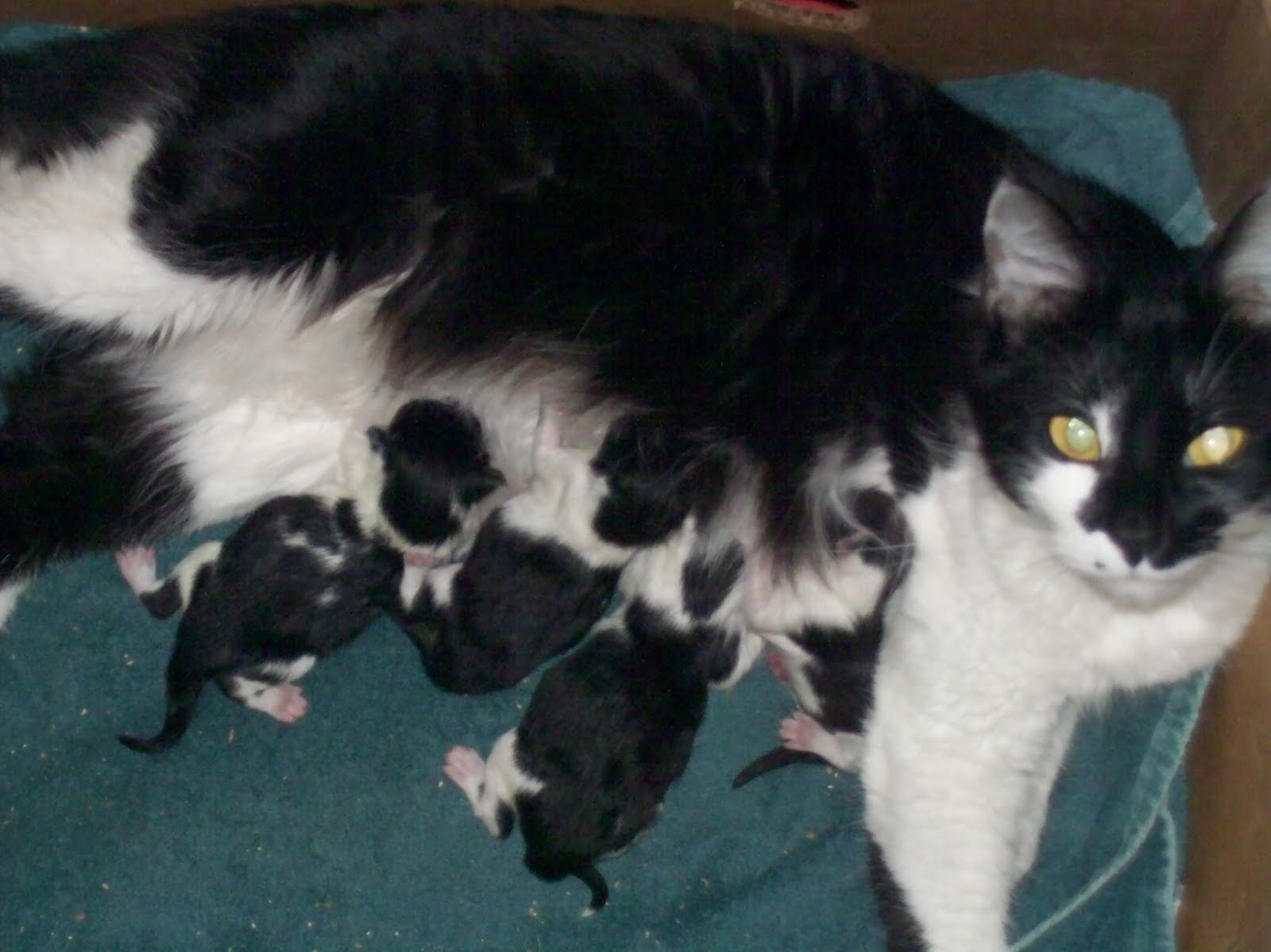
Yesterday morning at 4:30, she came to get me in bed. I brought a box lined with an old mattress pad and put it into the nest she’d made at the back of my son’s closet. She kept climbing into my lap, purring in between pushes. I kept putting her back in the box and patting her. After lots of purring and some yelling, out popped a huge kitten, followed by another. I left her nursing and purring, wondering if that was it.

It wasn’t. My husband came down to announce that there were four living kittens and one off to the side that didn’t make it. We took out the cold kitten, gave it a quickie funeral and burial, brought a dish of milk up to Minnie, changed the mattress pad.

Here they are—all black and white, like miniature Holsteins. Could this be the beginning of my cat farm after all?